
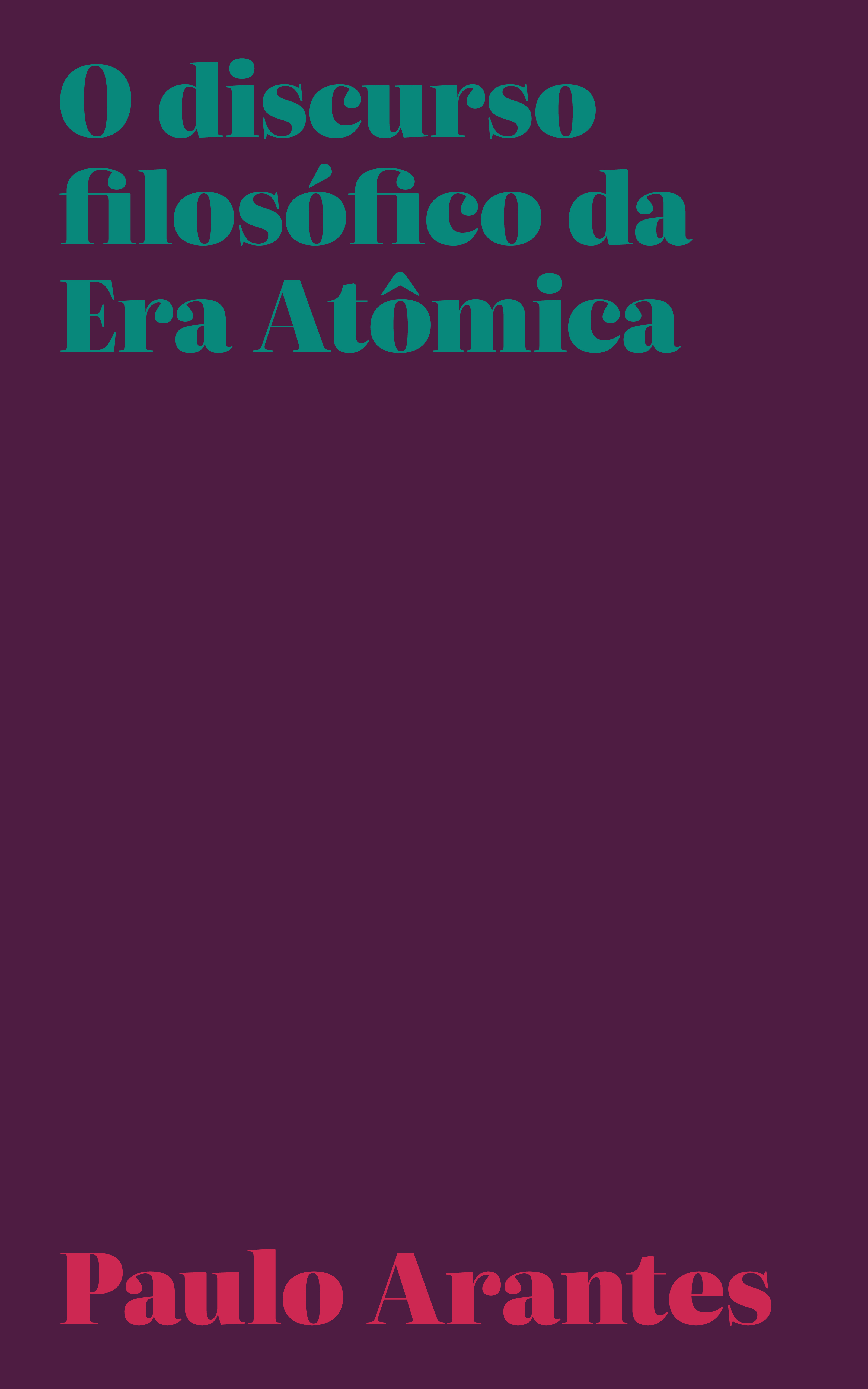
The Philosophical Discourse of the Atomic Age
2025
Synopsis
In an aphorism from Minima Moralia, written in the midst of the Second World War, Adorno imagines Hegel’s philosophy of history “extended into this time”. His observation on “Hitler’s robot bombs” as one of the empirical facts that symbolically express the present state of the “world spirit” is relatively well known: the latter is seen “not on horseback, but on wings and without a head”. One might say that Paulo Arantes, in seeking to answer the question “what time are we living in?”, posed by his friend Rancière, undertakes an exercise similar to Adorno’s, so that this essay could very well begin as follows: “Had Hegel’s philosophy of history extended as far as the fission of the atom...” All this is woven together both by the fundamental intuitions of the phenomenologist of the bomb, Günther Anders, and by the “exact fantasy” of Svetlana Alexievich’s documentary and literary narration as she listens to the Voices from Chernobyl, in “fragments interrupted by the recurrence of expressions such as ‘for the first time’, ‘never again’, ‘forever’”.
Everything points to a sequence of historical thresholds crossed within a course of time that is, by definition, irreversible. As one may imagine, we are dealing here with philosophical-speculative consequences that are far from innocent, all the more so coming from someone who has always refused the title of “philosopher” — not out of modesty, nor only because of the sense of ridicule ingrained in the consciousness of every critical Brazilian intellectual who, at least since Machado, has known how to disarm the syndrome of grandiloquence that contaminates the country’s mental and literary life, but because he understands that, in an emphatic sense, this discursive genre — quite distinct from a scientific discipline such as sociology, anthropology, and so on — has in fact been rendered obsolete (on this, see O fio da meada). This does not prevent us from thinking; quite the contrary. Indeed, this remains one of the subjects of this short book, especially in its second part, which identifies in Anders’s “occasional philosophy” the inheritance of a fundamental Socratic impulse, also recovered by Hannah Arendt in order to answer the question: “what makes us think?”
This second part, entitled “A Bomb Is a Bomb Is a Bomb”, and already known to us as the afterword to Hiroshima Is Everywhere, may well be read as an excellent essay — indeed, better than much of the international bibliography devoted to the subject — on the intellectual experience of Günther Anders, who lost his words before an object far too monstrous for literary and philosophical consciousness to give it form. As a whole, however, this Philosophical Discourse of the Atomic Age goes somewhat further. It is by no means trivial to recall that we are dealing with an author who devoted his formative intellectual years to elaborating a solid interpretation of the concept of time in Hegel and its corresponding historical form, and who, four decades later, sought to trace the contours — also far from philosophically innocent — of what would be a New Time of the World. There is a thread that stitches all this together and leads into this short book, but it is not obvious and requires many mediations. Thinking them through will be the task of its readers.
(Felipe Catalani)
Keywords: Günther Anders; Jacques Rancière; Svetlana Alexievich; Hiroshima; Chernobyl; time of the end.
Series
Categories
License

This work is licensed under a Creative Commons Attribution-NonCommercial-NoDerivatives 4.0 International License.