
Education through Waiting
2013
Synopsis
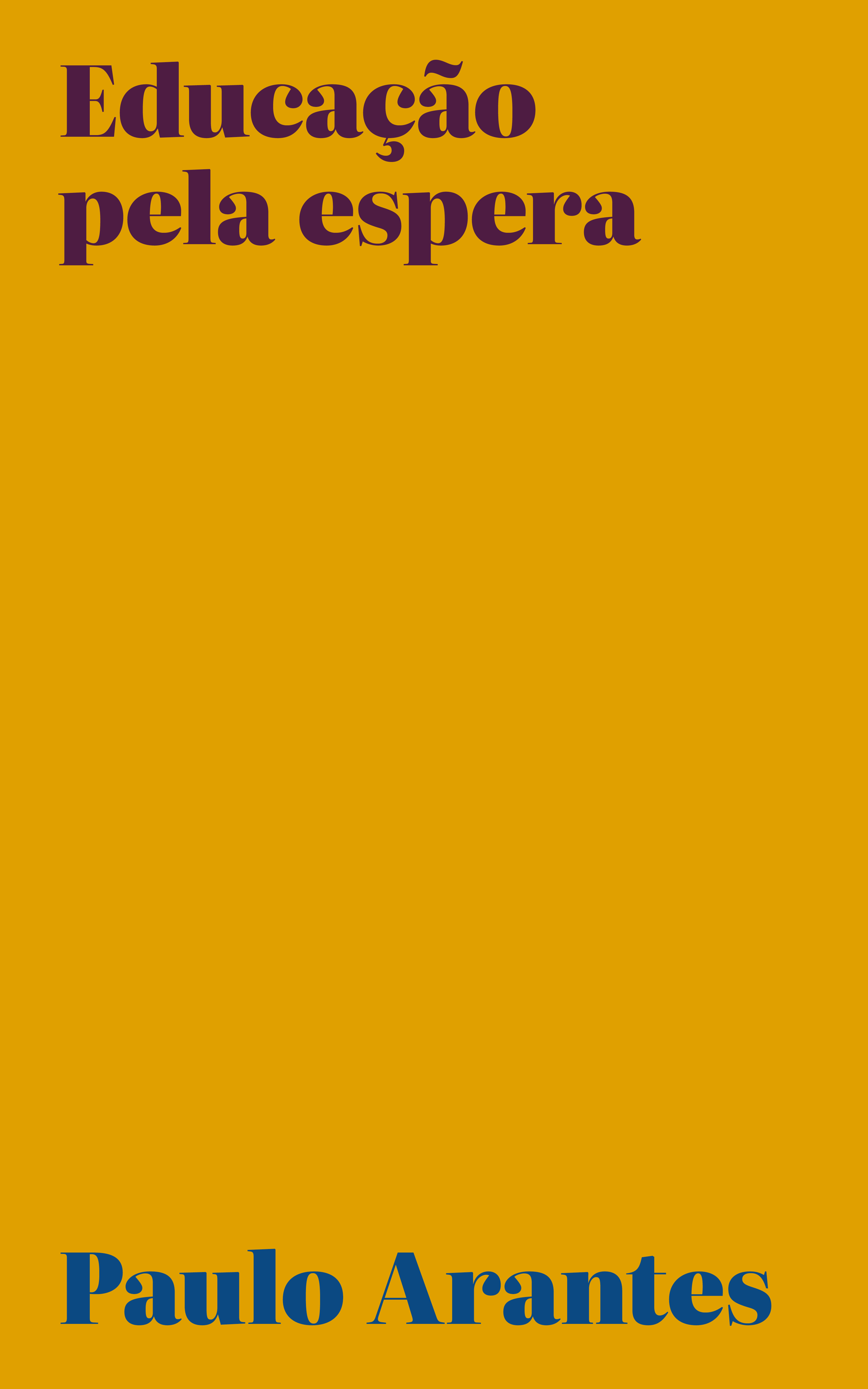
In A educação pela espera (Education through Waiting), a book now available to us thanks to the website Sentimento da Dialética, Paulo Arantes seeks to unravel the enigma running through Antonio Candido’s monumental essay on the Four Waitings. Part of the opening text is already well known, having been published in the volume Antonio Candido 100 anos (Antonio Candido: 100 Years), edited by Maria Augusta Fonseca and Roberto Schwarz. This time, however, it does not end with the hesitant “to be continued”; on the contrary, it gains unprecedented momentum with the entry of Carlos Drummond de Andrade, between A Rosa do Povo and Claro Enigma, as well as with the arrival of Thomas Mann and the waiting that educates no one in the sanatorium of The Magic Mountain.
What is at stake, then, is to show how a critic so personally peaceful and civil brings to the surface the motif of war, one of his favourite subjects, which had always remained concealed within his analytical and pedagogical concerns, but which formed part of a political apprenticeship in waiting in an age of total expectation, in Bloch’s sense. The force of the argument is consolidated insofar as the approach is also comparative: we are introduced to Antonio Candido’s war through “As batalhas”, from O Albatroz e o Chinês (2009), “As cartas do voluntário”, included in O Observador Literário (1958), and the equally striking essay on Conrad, “Catástrofe e sobrevivência”, in Tese e Antítese (1964).
This is not, therefore, just any war, but the war experienced by a man whose existence was inseparable from his century: total war, which laid bare reason itself and subjected the heirs of the Enlightenment and of the great revolutions — including the Russian Revolution — to a trial by fire. After the cold shower administered by Stalin, or, in Drummondian terms, with the arrival of the Russian in Berlin — that is, the confirmation of the betrayed revolution intuited by Trotsky — the expectation of World Revolution collapsed. What remained, on this side of the divide, were Third World intellectuals, immersed up to their necks in what Arantes defines as the long global civil war. Once the experiential content sustained by globalised Great Expectations had come to an end, the social regime of Waiting itself changed.
In the second movement, there is a new assessment of the world-catastrophe, which brings to the foreground A Talking Picture (2003), by the Portuguese filmmaker Manoel de Oliveira. In that film, the instantaneous action of “terror” breaks the historical link between modern war and the time of waiting, leaving us without answers. As an appendix to this vertiginous diagnosis, we also find the text “Da Noite para o Dia” (“From Night to Day”), in which the qualitative transformation of social expectations in the face of the reordering of time already appears.
Keywords: Antonio Candido; Four Waitings; War; Expectations; Present Time; Ernst Bloch; Manoel de Oliveira; Modesto Carone.
Series
Categories
License

This work is licensed under a Creative Commons Attribution-NonCommercial-NoDerivatives 4.0 International License.